
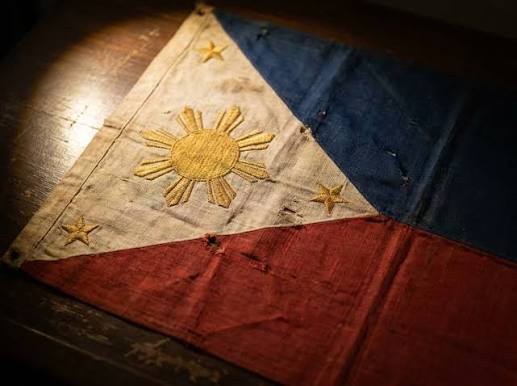
The Philippine Flag Has a Hidden War Mode, and It’s Written Into Law
What if the Philippine flag could tell the world whether the country is at peace or at war without changing its design? It may sound like an unusual piece of trivia, but the Philippines actually has a rule that does exactly that. When the country is at peace, the blue stripe stays on top. During wartime, the flag is flown with the red stripe above it.
This is not simply a symbolic tradition passed down through generations. The practice is written into Philippine law, making the national flag more than a representation of identity and independence. It also carries a message about the country’s condition, turning an ordinary-looking banner into a powerful national signal.
The Philippine Flag Has a Hidden Wartime Position
Most Filipinos are familiar with the flag’s usual appearance: blue on top, red below, with a white triangle, golden sun, and three stars. But there is another officially recognized way to display it. Under Section 10 of Republic Act No. 8491, the Flag and Heraldic Code of the Philippines, the red field must be placed on top when the country is at war. When displayed vertically, the positioning also changes, with the red field taking the prescribed wartime position.
This Rule Is Written Into Philippine Law
The wartime position is not an internet myth or an unofficial military custom. Republic Act No. 8491, signed into law on February 12, 1998, specifically establishes how the national flag must be displayed during peace and war. The rule also appears in earlier flag regulations, including Executive Order No. 321 issued in 1950. This means the flag’s orientation has a formal meaning that goes beyond decoration or personal interpretation.
The Red Stripe Carries a Powerful Message
The red field represents courage, bravery, and patriotism in the symbolism of the Philippine flag. Placing it above the blue during wartime creates a visible signal that the country is facing armed conflict. The tradition also has historical roots in the Philippine struggle for independence and later wartime experiences. During World War II, the flag was flown with its red field above the blue as the country fought against Japanese occupation.
Not Every Upside-Down Flag Means the Country Is at War
Because the flag has a designated wartime position, seeing it displayed incorrectly can cause confusion or concern. There have been public incidents involving Philippine flags displayed with the red stripe on top during international events, including an ASEAN-related post in 2019 and a diplomatic photo in 2023. These cases drew attention from Filipinos who recognized the wartime meaning. However, an accidental display does not automatically mean the country is at war; it can simply be a mistake in handling or protocol.
ALSO READ: There Should Be a Law in the Philippines on Refund Every Time There Is an Internet Outage
A National Symbol That Communicates Without Words
The Philippine flag is more than a combination of colors and symbols. Its white triangle represents equality and fraternity, its sun represents liberty, and its three stars represent Luzon, the Visayas, and Mindanao. Its wartime orientation adds another layer of meaning, showing how a national symbol can communicate a country’s condition through a simple change in position. For Filipinos, knowing this detail is one way of understanding the history and responsibility carried by the flag we see every day.
Take a closer look
The next time you see the Philippine flag flying, take a closer look at which color is on top. That small detail carries a meaning many people may not immediately recognize. The country’s national banner is designed to represent peace in its usual position and signal wartime status when its red field is raised above the blue. It is a reminder that even the smallest details of our national symbols can carry generations of history.