Gibo Teodoro’s Lesson: Choose Courage
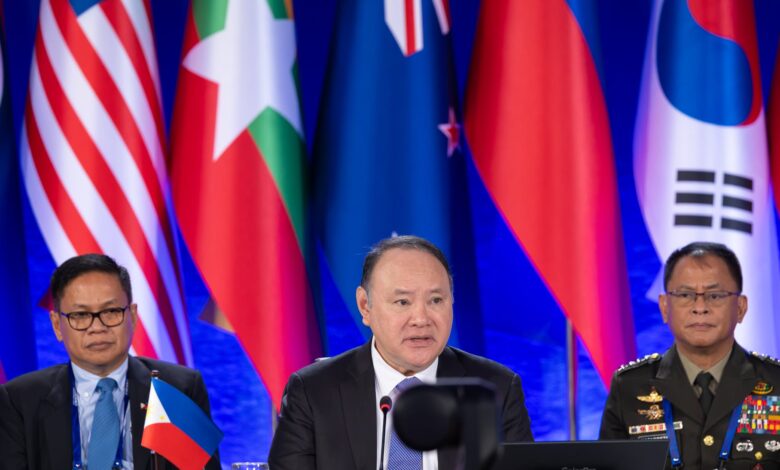
On a stage in Seoul on September 8, Defense Secretary Gilberto “Gibo” Teodoro Jr. was halfway through an answer about the law of the sea when a staffer handed him a note. Forum organizers later said a Chinese military attaché had passed it along.
Teodoro read it to the whole room.
The note repeated Beijing’s line that the 2016 arbitral award is “illegal, null and void.” He took it apart one sentence at a time. When it said China rejects the ruling, he answered, “Of course, because you lost.” He called the episode “actual coercion, bullying and aggression,” to applause. A Singapore-based analyst described the moment as “an embarrassment for China.”
Critics called it showmanship. But the exchange also offered a lesson in choosing courage. Keeping quiet can feel practical: avoid the confrontation, spare everyone the discomfort, move on. Yet when silence becomes a habit, it carries a cost. Teodoro’s stand showed what it looks like to speak up deliberately—and accept the consequences.
Why Talking Back Matters
At the Senate hearing on his department’s 2027 budget on October 19, Teodoro explained the thinking behind his approach. China’s messaging, he said, is part of its “United Front Work.”
His warning: “If we don’t stand up against that narrative, it will be normalized. They will say, ‘You accepted it; you didn’t say anything.’”
His conclusion was blunt. It is “better to stand up for what is right, rather than lose what is ours by default.”
Repeated claims can become accepted assumptions when nobody challenges them. For a country defending its maritime rights, answering those claims matters.
When the Chinese ambassador said in October that Beijing could “easily win” if it used force, Teodoro called it what it was. “Banta ’yon,” he said on radio. “Tinatakot tayo.”
When China’s embassy accused him of cutting military hotlines for “political self interests,” he reminded everyone that he had suspended those direct lines about three years ago because they were being abused. Talks could return, he said, once China stops its “predatory activities.”
In August, during a row over Chinese workers arrested in raids on steel plants, he dismissed Beijing’s reply as a “squid tactic”—disinformation by avoidance.
Beijing has not taken it quietly. In June, it sanctioned him, barring him and his family from the mainland, Hong Kong and Macau. His willingness to challenge China publicly has come with personal consequences.
What Standing Firm Looks Like at Sea
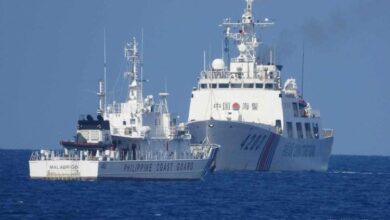
The clearest example is a rusting ship. The BRP Sierra Madre has sat on Ayungin Shoal since 1999 with Filipino Marines aboard. In September, Chinese warships and coast guard vessels turned back a resupply run about 111 kilometers from the shoal.
Teodoro’s answer was simple: “Definitely, whatever happens, kailangan gawin. That is a principle.”
A resupply got through on October 21.
When talk surfaced of China towing the ship away, he warned that trying it by force would be an “act of war.” He distinguished that from a formal declaration of war, leaving decisions on escalation to the country’s constitutional authorities.
Behind the words sits a strategy. His Comprehensive Archipelagic Defense Concept moves the Armed Forces away from decades of fighting insurgents in the hills and toward guarding the sea, with the aim of projecting presence at least 200 nautical miles out. The modernization plan approved in 2024 runs ten years and buys the ships, aircraft and sensors that concept needs.
Standing firm requires more than a forceful answer at a forum. It requires the capacity to maintain a presence, supply Filipino personnel and protect the country’s rights.
Building the Means to Stand Firm
The defeatist argument is familiar: China is too big, wala tayong laban, better to get along and keep quiet.
The imbalance in military power is real. That makes partnerships essential. During Teodoro’s tenure, the Philippines has built or deepened several:
- United States: Nine EDCA sites, a Task Force Philippines backing the archipelagic defense plan, and the Typhon and NMESIS missile systems used in Balikatan.
- Japan: The Reciprocal Access Agreement, which brought about 1,400 Japanese troops to Balikatan this year, and coastal radars handed over in February under Japan’s Official Security Assistance.
- Australia: A new Defense Cooperation Arrangement to replace the 1995 agreement, advanced with Richard Marles in Darwin in August.
- Canada and New Zealand: Visiting forces agreements approved by the Senate 19–0 in August. Teodoro also made the first official visit to Canada by a Philippine defense secretary in June and signed a logistics support arrangement.
- France: A visiting forces agreement signed in Paris in March.
- United Kingdom: Formal talks on a visiting forces agreement opened in August.
- South Korea: Twelve more FA-50 fighters under a $700 million deal signed in 2025, plus September talks with HD Hyundai on expanding naval shipbuilding in Subic.
- India: BrahMos coastal missile batteries now operated by the Marines.
- Vietnam: A defense cooperation memorandum signed in June.
Only the American relationship includes a mutual defense treaty. These partnerships carry different commitments and should not be mistaken for identical guarantees of military support.
Still, they give the Philippines more options: equipment, training, information and diplomatic backing. They also challenge the claim that the country can do nothing but submit.
The Fair Objections
His critics deserve a hearing. Some analysts warned that the Seoul moment could invite a sharper Chinese response at sea. Beijing’s foreign ministry told him to cut the “provocations and theatrics.” A Chinese scholar argued that he was out of step with the President, who said in August that joint oil and gas exploration with China was a “distinct possibility.”
Online, people call him a warmonger.
He has answered that accusation directly. “Hindi giyera ang pinag uusapan natin,” he said in October. “Naninindigan lang tayo sa pride ng bansa natin.”
He has also asked who keeps escalating, since Filipino boats are not the ones sailing into China’s waters.
The legitimate test is whether his approach helps protect Filipino personnel, sustain the country’s maritime presence and defend its rights while managing the risk of conflict. Applause at a forum cannot settle that question. The work at sea and the capabilities being built must carry the argument.
That record includes resupply missions, radars, missile batteries and defense agreements across several continents. Former Justice Antonio Carpio also said the Seoul exchange strengthened the country’s legal position before the world.
Plenty of officials say they defend the West Philippine Sea. Teodoro says it on the record, in rooms where China is listening, and keeps building the means to back it up. That deserves recognition—and continued scrutiny of the results.
The lesson reaches beyond defense policy. For Teodoro, courage meant reading a note aloud in Seoul. For another Filipino, it might mean correcting a false post shared by a relative, challenging an abuse at work, or asking the question everyone in a meeting avoids.
Staying quiet will often feel like the practical move. His stand is a reminder that speaking up, calmly and with facts, remains a choice.