
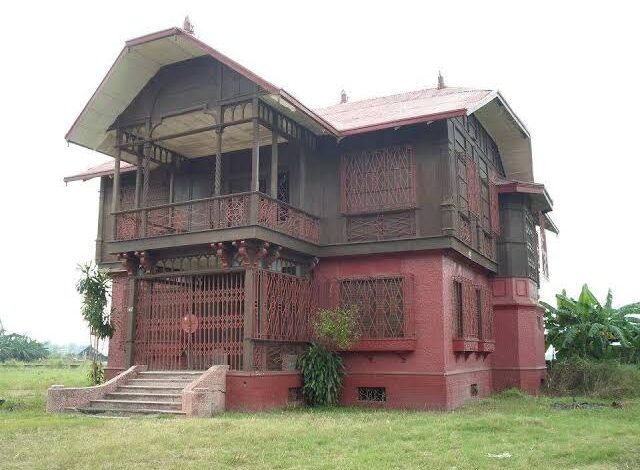
They Say Bahay na Pula Is Haunted. Its History Is Even More Terrifying.
Every haunted house has a story. Some are whispered through neighborhood gossip, passed down by generations, or told around a campfire just in time for Halloween. But in Barangay Anyatam, San Ildefonso, Bulacan, there is a house whose history is far more disturbing than any ghost story. Known as Bahay na Pula, or the Red House, this once-grand mansion has long been associated with stories of paranormal activity.
Locals have spoken of strange sightings and unexplained occurrences around the abandoned property. Yet behind its eerie reputation lies a documented history of wartime violence, suffering, and a decades-long fight for justice.
And perhaps the most haunting thing about Bahay na Pula is that its story remains unfinished.
A Mansion With a Dark Past
Built in 1929, Bahay na Pula was originally owned by the wealthy Ilusorio family. The two-story wooden mansion stood in Barangay Anyatam, San Ildefonso, Bulacan, near the village of Mapaniqui in Candaba, Pampanga.
Before World War II reached its darkest chapters in the Philippines, the property was a private residence. But when Japanese forces occupied the country, the house was converted into a military barracks and headquarters.
Its location would eventually connect it to one of the most painful episodes of the Japanese occupation: the wartime sexual enslavement of Filipina women.
What Happened Inside Bahay na Pula During World War II?
On November 23, 1944, Japanese troops raided Mapaniqui, Candaba, Pampanga. Women and girls from the village were forcibly taken to Bahay na Pula, where Japanese soldiers detained and sexually abused them.
According to the United Nations Committee on the Elimination of Discrimination against Women (CEDAW), 24 Filipina survivors who later brought a complaint against the Philippine government were held at the Red House for periods ranging from one day to three weeks. They endured repeated rape, other forms of sexual violence, torture, and inhumane detention conditions.
These women became part of the group known as the Malaya Lolas, which translates to “Free Grandmothers.” Their accounts documented the atrocities committed against them and the lasting consequences they carried long after the war ended.
The term “comfort women” was used for women and girls forced into sexual slavery by the Japanese military during World War II. Despite the name, there was nothing voluntary or comforting about their experiences.
For the survivors, the end of the war did not mean the end of their suffering. Many faced physical, psychological, social, and economic consequences, while their calls for recognition and compensation went unanswered for decades.
The Women Who Refused to Let History Forget
For years, the survivors struggled to bring their experiences into public view. In 1996, Filipina survivors began speaking openly about the atrocities they endured during the Japanese occupation.
Their fight for justice continued through legal petitions, public campaigns, and appeals to international human rights organizations.
In 1998, the Malaya Lolas sought assistance from the Philippine government to pursue claims against Japanese officials and military officers. Their efforts encountered repeated setbacks, including the dismissal of their petition before the Philippine Supreme Court.
However, their campaign reached an important milestone in March 2023.
The United Nations Committee on the Elimination of Discrimination against Women found that the Philippine government had violated the rights of the 24 survivors who filed the complaint by failing to provide adequate reparation, recognition, and social support.
The committee recommended full reparation for the women, including financial compensation and an official apology. It also called for the preservation of Bahay na Pula as a memorial, or the establishment of another commemorative space to honor the survivors and their struggle for justice.
It was an important recognition of a fight that had lasted generations.
Is Bahay na Pula Still Standing?
Today, Bahay na Pula is a shadow of the mansion it once was.
The property was partially demolished in 2016, reportedly amid disputes involving the Ilusorio family’s ownership and inheritance. Its original structure suffered further deterioration, with parts of the building stripped away and left exposed to the elements.
Photographs taken in 2022 show remnants of the old mansion, including portions of its deteriorating structure.
Efforts to preserve the site have faced complications because the property remains privately owned by the Ilusorio family. In 2023, advocates from the Malaya Lolas renewed calls to transform the location into a shrine or museum.
For them, preserving Bahay na Pula means more than protecting an old building. It means giving the survivors a place where their stories can be remembered and where future generations can learn about the atrocities committed during the war.
The United Nations recommendation also recognizes that if the original site cannot be preserved, another memorial space should be established.
Why Is Bahay na Pula Considered Haunted?
People who pass by Bahay na Pula have long shared stories about strange sights around the abandoned property. Some speak of figures appearing near its windows and veranda, only to disappear when someone looks again.
Imagine walking past the old red house after sunset. The road is quiet. The windows are dark, and the building stands motionless behind its weathered walls. Then, from the corner of your eye, you notice someone standing behind an upstairs window.
A woman.
She does not wave. She does not move. She simply watches.
You turn to look directly at her, but the window is empty. There is no movement inside, no light, no sign that anyone could be living there. Still, the feeling that someone is watching follows you long after you’ve left.
READ: 4 Haunted Universities in Manila
Stories like this have helped turn Bahay na Pula into one of Bulacan’s most talked-about haunted places. Whether these sightings are products of folklore, imagination, or something people cannot explain remains unknown.
But the house carries a history far more disturbing than any ghost story.
A Haunted House That Deserves to Be Remembered
Halloween often brings stories of abandoned mansions, restless spirits, and places people are too afraid to visit after dark. Bahay na Pula certainly has the atmosphere of a classic haunted house.
But reducing its history to a ghost story would mean overlooking the people who suffered there.
The women of the Malaya Lolas spent decades fighting to have their experiences acknowledged. Their struggle reminds us that historical atrocities do not disappear simply because the buildings where they happened fall into ruin.
Whether Bahay na Pula is remembered as a haunted house, a wartime landmark, or a symbol of an unfinished fight for justice, its history deserves to be told.
Because sometimes, the stories that deserve to haunt us are the ones we must never forget.