Marilao River Wall Collapse: What Marcos’s New Flood Control Plan Really Admits
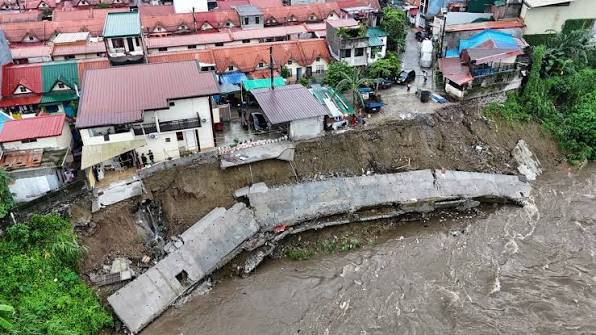
On August 10, a P5 million river wall in Barangay Prenza II, Marilao, Bulacan collapsed. It was two months old.
Contractor JB Construction denied cutting corners, saying it followed the required steel specifications and cement thickness. Marilao’s mayor ordered the same contractor to rebuild it at its own expense. And ten days later, President Marcos ordered a different set of agencies to start looking at an entirely different flood control strategy: underground water cisterns, capable of storing floodwater during storms and releasing it during the dry season, at as many as 39 identified catchment sites across the country.
Nobody in government connected these two events out loud. But look at the timing and the connection is hard to miss. The Marilao wall is not an isolated failure. It is one data point in a pattern that has made the country’s default flood control tool, the concrete wall or dike, politically and structurally suspect. The pivot to cisterns is not just a new idea. It looks like a quiet admission that the old one no longer has the government’s own confidence.
A wall that failed the test it was built for
The Marilao collapse deserves more scrutiny than it got. The structure was 45 meters long and 12 meters high, finished only in June 2026. When it gave way on August 10, witnesses described the ground simply opening up. Children nearby thought it was an earthquake. The contractor blamed water saturated soil. Critics asked the more obvious question: isn’t accounting for soil saturation exactly what a flood wall is supposed to do before it is ever built?
Bulacan is not just any province in this story. It has become shorthand for the entire flood control corruption scandal. Data from the government’s own Sumbong sa Pangulo portal shows 668 flood control projects concentrated there, worth a combined P43.75 billion, the largest allocation for any single province in the country. Former engineers from the Bulacan 1st District Engineering Office have already come forward describing a kickback scheme in which officials and lawmakers allegedly funneled public money into projects that existed mostly on paper.
So when a brand new wall in that same province fails within two months, it does not read as bad luck. It reads as confirmation of what investigators have been saying for a year: that a meaningful share of flood infrastructure built since 2022 may not have been engineered to actually hold back water, corruption or not.
The quiet pivot nobody is asking about
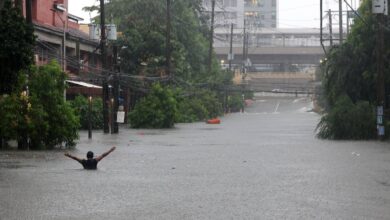
This is where the timing becomes interesting. On August 20, just over a week after the Marilao collapse and after floodwaters again submerged large parts of Metro Manila and Luzon, the Palace announced that Marcos had directed agencies to explore underground cisterns as a flood mitigation tool, alongside a broader instruction to study flood control approaches used by other countries.
Presidential Communications Office Undersecretary Claire Castro told reporters that recent floodwaters were enough to fill at least 50,000 Olympic sized swimming pools, and that 39 sites had already been identified as potential water catchment basins. A separate report the same day pointed to 30 candidate sites for underground cisterns specifically in Metro Manila.
On paper, this sounds like innovation. Water storage infrastructure is common in flood prone cities elsewhere, and it addresses a real gap: walls and dikes only redirect water, they do not reduce the total volume the system has to handle. But no official has said the quiet part, which is that this pivot is also a hedge against a structural category the government can no longer fully trust. You cannot easily fake the depth or capacity of an underground cistern the way you can allegedly fake the specifications of a river wall built along a stretch of provincial river with minimal oversight. Storage infrastructure is harder to make disappear on paper. That may be as much of the appeal as the engineering logic.
The budget still does not match the confidence
Here is the part that undercuts the optimism before it even starts. The 2027 national budget proposal includes P107.4 billion for flood control, and notably, a portion of that is earmarked not for new construction but for maintenance, repair, and rehabilitation of existing infrastructure. That is a meaningful admission in itself: a significant share of the money already spent needs to be spent again just to keep already built structures functional.
Compare that to the bigger number that has been circulating this month. Former DPWH secretary Rogelio Singson has put total flood control spending over the last ten years at P1.78 trillion, of which roughly P1.2 trillion falls under the current administration, more than double what was spent under the previous one. Reuters has separately reported that the government identified irregularities in P545 billion worth of flood control spending since 2022 alone.
Set those numbers next to each other and a blunt picture emerges. The country has already spent more on flood control than at any point in its history, a third of a trillion pesos of that total is now formally flagged as irregular, and the government’s response to a wall failing after two months is to fund a new and different kind of infrastructure rather than to first explain why so much of what has already been built cannot be trusted to survive a single monsoon season.
What Marikina still gets right that Bulacan does not
The contrast with Marikina remains the most useful comparison in this story, but not for the reason most coverage uses it. Marikina’s flood resilience was never really about walls either. It rests on decades of continuous river maintenance, legally defined river boundaries, and year round dredging using amphibious excavators, work that Mayor Marcy Teodoro has described as an ongoing responsibility rather than a finished project.
Even Marikina is not immune to the current strain. During this same stretch of August rains, DPWH had to repair a damaged generator powering two mobile pumps at the Tumana Pumping Station, one of the city’s key anti flood facilities, after it went offline. The difference is that when a critical piece of Marikina’s flood system fails, it gets repaired and restored to operation within the same news cycle, because the city treats pumping stations and dredging schedules as permanent infrastructure that needs constant upkeep. In Marilao, when a wall failed, the response was an investigation and a directive to the same contractor to rebuild it. One city treats flood control as maintenance. The other still treats it as a one time construction contract.
That is the real lesson the cistern pivot risks missing. New infrastructure, however promising, will fail the same way the walls did if it is not paired with the unglamorous, unpolitical, decades long commitment to upkeep that made Marikina’s system different in the first place. A cistern that nobody dredges, inspects, or maintains after the ribbon cutting is just a more expensive way to repeat the same mistake underground.
READ: Flood Control Projects: Timeline of Anomalies
The honest question the government has not answered
The Philippines does not need the public to be told that another flood mitigation idea exists. It needs someone in government to say plainly why a two-month-old wall failed, whether that failure is isolated or symptomatic of a wider construction quality problem across the P43.75 billion worth of Bulacan projects, and what specifically will stop the same failure from repeating at 30 or 39 new underground sites.
Until that explanation comes, the cisterns will read less like a solution and more like a confession that arrived without anyone actually saying what it was confessing to.