What causes ALS? Scientists still seek answers
Scientists still cannot explain why most people develop amyotrophic lateral sclerosis (ALS), a progressive disease with no known cure. Most cases are sporadic, with no family history to point to. Researchers have tied a minority of cases to inherited mutations and identified a few outside risk factors, but no single cause explains the disease.
What ALS does
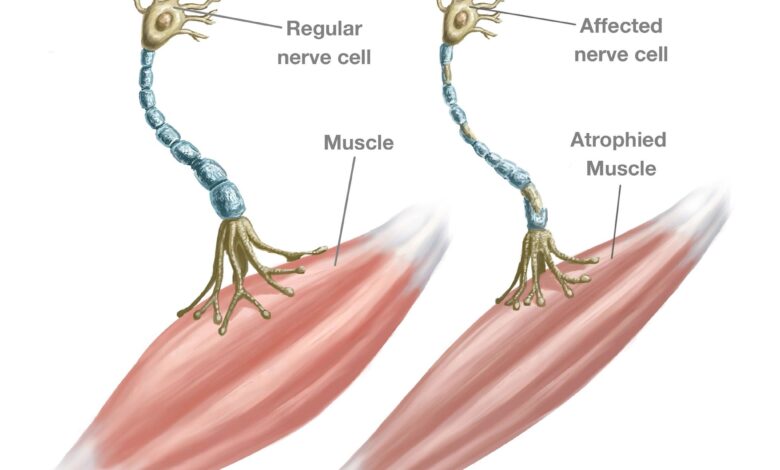
ALS, also called Lou Gehrig’s disease, attacks the upper and lower motor neurons, the nerve cells that control voluntary muscles. As those cells die, muscles weaken, waste away and twitch, and the loss spreads to the muscles used for speaking, swallowing and breathing.
Most patients die from respiratory failure, usually within three to five years of the first symptoms, according to the U.S. National Institute of Neurological Disorders and Stroke (NINDS). About 10 percent live a decade or more. The disease does not affect sight, hearing, smell, taste or touch.
Genetic factors
About 10 percent of cases are familial, meaning inherited, and the rest are sporadic. Researchers have linked more than a dozen genes to the inherited form. Most people with a familial form have a 50 percent chance of passing it to each child, according to the ALS Society of Quebec.
A defect in C9orf72, discovered in 2011, accounts for roughly 25 to 40 percent of familial cases, according to Montefiore Einstein. Mutations in SOD1, the first ALS gene identified, in 1993, account for another 12 to 20 percent. Defects in both genes also turn up in a small share of sporadic cases.
Environmental influences
Smoking is the only outside factor that studies have firmly tied to higher risk, according to the ALS Society of Quebec. Other exposures, including lead, pesticides and other chemicals, remain under study.
Such factors are hard to pin down because many people share the same exposures but never develop the disease. One theory holds that people already at genetic risk develop ALS after contact with a trigger such as a toxin.
No known way to prevent ALS exists, according to Montefiore Einstein.
READ: Bad Sleep Ages Your Brain Faster Than You Think
Where research stands
Existing drugs may prolong survival or slow decline, but none reverses the damage to motor neurons, according to NINDS. Riluzole may extend survival by several months, and tofersen (Qalsody) is given by spinal injection to patients with SOD1 mutations.
New candidates are in trials. On Feb. 23, QurAlis announced early Phase 1/2 data for QRL-201, a drug tied to the protein STMN2. Levels of that protein fall in motor neurons when abnormal TDP-43 is present, as it is in nearly all ALS cases, according to the ALS Society of Canada.
Researchers are also testing neurofilament light, a protein released when neurons are damaged, as a marker for who is likely to progress to ALS. It is being used in a presymptomatic trial called ATLAS.