

Inuman Chronicles: Tag-Ulan Edition
May baha pa man, umiinom pa rin tayo. But with the tagay, let's also talk about what we keep laughing off every rainy season.
The clouds roll in sometime in June, usually without much warning, the way most things tend to happen. One afternoon, it’s sunny, and then suddenly it’s gray and humid. And the streets are three inches under flood. Yet somewhere in that chaos, a bottle gets opened. Because that’s just what we do. Bagyo man o wala, the Filipino inuman is, among many things, genuinely weatherproof.
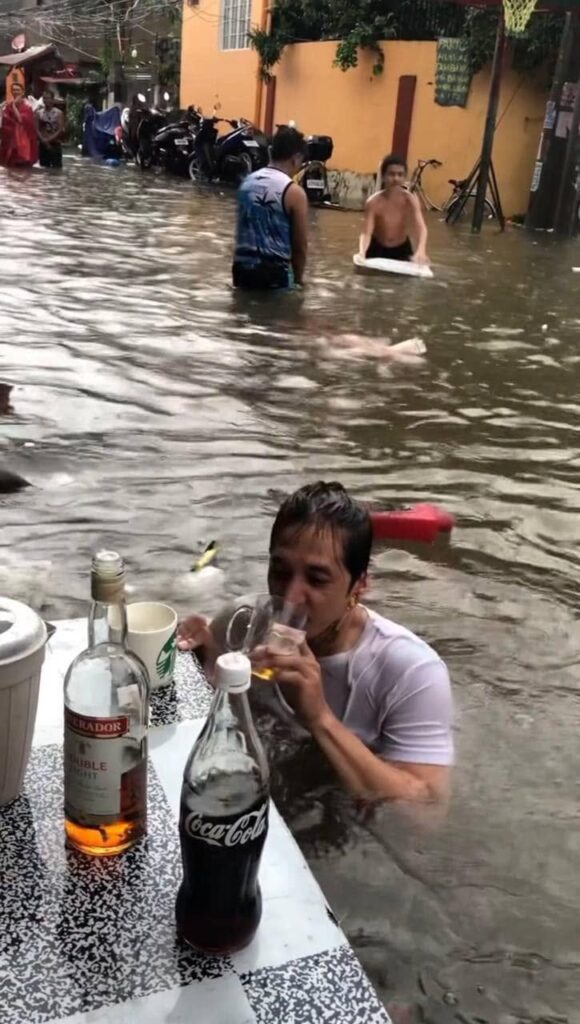
The Rain Shifts the Inuman
Summer inuman has its own energy; open air, late nights, the kanto. But tag-ulan inuman is a different creature entirely, and anyone who’s sat through one knows exactly what it feels like.
The group moves inside, which makes everything slightly more crowded and therefore slightly better. The sound of rain on the rooftop becomes the backdrop, that specific kind of heavy drumming that makes you feel like the outside world has been cancelled for the evening. Someone lights a candle when the power goes out. Someone else adds extra ice to the glass because the drink was barely cold. Even the pulutan shifts too. Because the rainy season calls for something hot, sinigang, goto, or whatever ulam you had for lunch is boiled again for pulutan.
The tagay flows the same way it always does; one glass, passed around, equal shares, no hierarchy. But the conversations get longer in the rain. Nobody’s in a rush to leave when the streets are flooded, inuman stretches. The night deepens. The tagay keeps going.
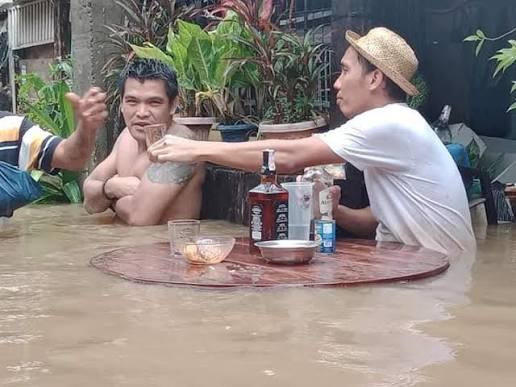
“Baha ka lang, Manginginom Kami!”
Every Filipino who has lived through a rainy season has either seen this meme or received it. The photo varies; sometimes it’s a group of guys with their pants rolled up, bottles in hand, sitting on monobloc chairs with water around their ankles. Sometimes it’s a screenshot of a flooded street with a superimposed caption.
We share these because they’re funny.
Filipino people choosing to drink despite, or maybe because of, the chaos around them. This is real, and it captures something genuinely true about how Filipinos process difficulty.
But here’s the thing about that meme that we usually scroll past: those people in the floodwater aren’t on vacation. They’re on their own street. That flood water is coming from somewhere, and it’s in places it shouldn’t be. The laughter is real, and so is the bond. But so is the flooded house waiting for us when the night ends.
Inuman, in this context, brings comfort and camaraderie.

Let’s Keep Talking About It
Every June, reliably, the conversation resurfaces. Bakit parang hindi natatapos ang problema sa baha?
And then next rainy season, same conversation. Same flooding. Same memes.
The accountability conversation is real, and it matters. Who gets the contracts, who monitors the drainage maintenance, which LGUs are actually clearing esteros versus just announcing they’re clearing esteros, and whether the flood control budget is going where it’s supposed to go. These aren’t unanswerable questions. They’re just inconvenient ones, especially for people who’d rather not answer them.
But here’s what we know, even if we don’t say it in so many words: hindi lang sila ang may kasalanan.
The clogged drain in front of your house, who cleans that? Who threw those plastic sachets in the canal? The estero that your barangay uses as a secondary dump, who enabled that? Flood control is absolutely a government failure. It is also, in smaller but not insignificant ways, a collective habit that we keep practicing and then wondering why it doesn’t improve.
We are allowed to demand better from the government, and stop throwing garbage in the canal. Both things can be true. Both things are true.
The Rain Will Come Back. It Always Does.
By the time you’re reading this, the first real rains have probably already arrived.
Baha memes will start. The tagay will resume, the pulutan will be hot, and the conversation will drift… from the week’s gossip to politics to basketball to the rain hammering the roof to “uy, parang bumabaha na sa labas.”
That’s fine. That’s good, actually. The inuman is one of the few places Filipinos get to be honest with each other without a filter — and some of the most important conversations this country needs to have started exactly that way, around a glass being passed from one hand to the next.
So here’s the offer: enjoy the tagay. Enjoy the sound of rain and the people who didn’t leave even when the streets got bad.
And then, when the glass comes back around, and the mood is right, maybe don’t change the subject.
The flood conversation is one we can afford to have. The flood, increasingly, is one we cannot afford to keep ignoring.
Drink responsibly.