PISA 2025 Shows Filipino Students Are Improving in Reading, But Is It Enough?
The Philippines PISA 2025 results offer a welcome sign of progress for Philippine education, with Filipino students posting higher scores in Reading, Mathematics, and Science than they did in 2022.
That is worth celebrating. But the numbers also come with an important reminder: Philippine education is improving, but it is not out of the woods yet.
The Philippines Improved Across Reading, Math, and Science According to PISA 2025 Results
The biggest takeaway from PISA 2025 is remarkably simple: scores went up across all three core subjects.
Filipino students recorded an average score of:
- 373 in Science, up 17 points from 2022
- 371 in Mathematics, up 16 points
- 367 in Reading, up 20 points
The Philippines also performed above its 2022 results in all three subjects and above its 2018 results as well. Reading recorded the largest three-year gain, which is particularly notable given how important reading comprehension is to practically every other area of learning.
Still, these scores need some context. Filipino students remain below the OECD average in all three subjects.
More Students Are Reaching Basic Proficiency
Average scores are useful, but they can sometimes feel abstract. A more relatable measure is how many students can demonstrate at least a basic level of proficiency.
In PISA, Level 2 is considered the minimum level of proficiency in Science, Mathematics, and Reading. For example, a student reaching Level 2 in Reading can identify the main idea of a moderately long text and find information based on explicit criteria. In Mathematics, they can recognize how a simple real-world situation can be represented mathematically.
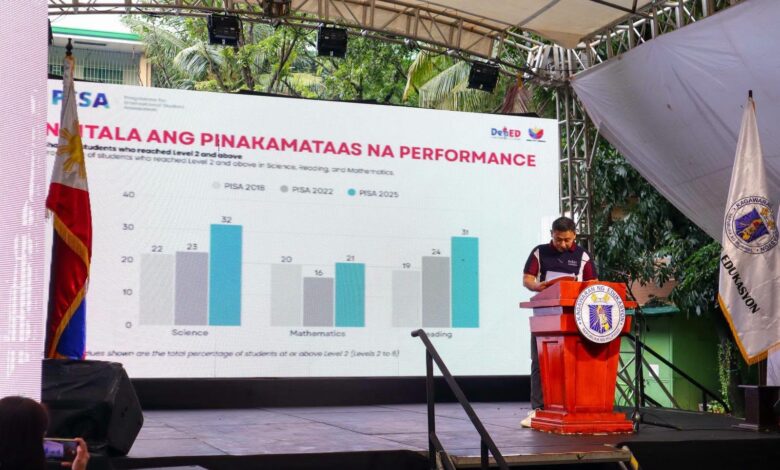
In the Philippines, the share reaching Level 2 or higher in 2025 was:
| Subject | 2022 | 2025 |
|---|---|---|
| Science | 23% | 32% |
| Mathematics | 16% | 21% |
| Reading | 24% | 31% |
That means the proportion of Filipino students reaching the minimum proficiency level increased substantially in Science and Reading, while Mathematics also posted a gain.
The OECD also notes that compared with 2018, the share of low-performing students fell by 11 percentage points in Reading and 10 percentage points in Science.
The Improvement Comes With a Reality Check
It’s tempting to look at the higher scores and declare that the Philippine education crisis is finally turning around.
We’re not there yet.
Only 32% of Filipino students reached Level 2 or higher in Science, 21% in Mathematics, and 31% in Reading. Those shares remain well below the OECD averages of 74%, 65%, and 69%, respectively.
The Philippines also had a much smaller share of top-performing students than the OECD average. So while the direction is encouraging, the gap remains significant.
There is another issue worth watching, too. Between 2022 and 2025, the gap between the highest- and lowest-performing students widened in Science, even though it did not change significantly in Mathematics and Reading.
That means improvement needs to be about bringing more Filipino students forward, not simply raising the performance of those who are already doing well.
READ: DepEd to Teach Proper Condom Use Starting Grade 8
Can the Philippines Keep the Momentum Going?
For DepEd and Education Secretary Sonny Angara, the latest PISA results are less a finish line than a benchmark for what needs to happen next. The department says it will focus on closing achievement gaps, strengthening school safety, including the growing concern around cyberbullying, and deepening support from parents, LGUs, and the private sector.
DepEd has also been working to use international assessment results more directly in teacher training and classroom practice, including efforts to identify learning gaps and strengthen literacy, numeracy, scientific literacy, and higher-order thinking.
Taken together, the Philippines PISA 2025 results suggest that the gains are encouraging, but the bigger challenge is making them last. The results show that Filipino students can move forward; the next step is making sure that progress reaches more students and continues in the years ahead.