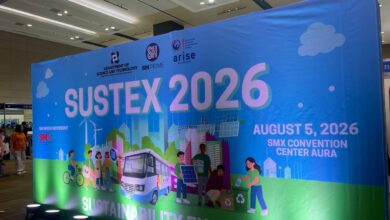
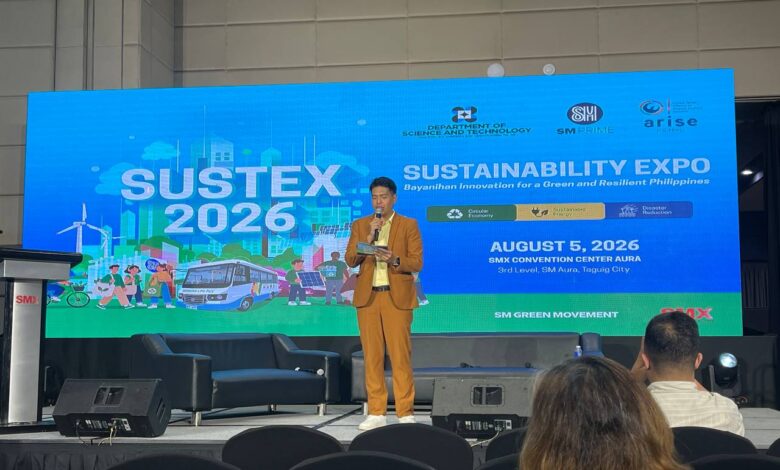
SUSTEX 2026 Shows That Philippine Climate Innovation Is Already Here
SUSTEX 2026 offered a surprisingly simple answer to a complicated question: What does climate innovation actually look like in the Philippines?
It can look like a satellite tracking land that has been slowly sinking in Bulacan. An electric tricycle that works with vehicles Filipino drivers already own. Discarded chopsticks turned into furniture.
None of these seem connected at first. But together, they reveal something interesting: Philippine climate innovation isn’t waiting for the future. It’s already happening.
SUSTEX 2026 Put Real Problems on Display
Held at the SMX Convention Center Aura under the theme “Bayanihan Innovation for a Green and Resilient Philippines,” the event brought together scientists, businesses, universities, startups, and government agencies.
But the exhibition wasn’t simply about showing off new technology.
The solutions addressed problems Filipinos already know: flooding, waste, transportation, infrastructure, and disaster preparedness.
That made the event feel less like a preview of some distant future and more like a look at solutions already taking shape.
Looking at Climate Risks From Space
One of the most unexpected examples came from above.
During her presentation on Earth Observation and Disaster Risk Reduction, Ms. Trixie Estomata showed how satellite technology can help monitor floods, track environmental changes, and support disaster preparedness.
One example focused on Sitio Pariahan in Bulacan, where satellite radar detected ground subsidence of more than 10 millimeters per year between 2003 and 2020.
From the ground, the change isn’t necessarily obvious. From space, it is.
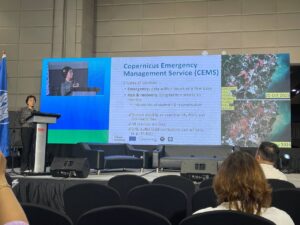
Estomata also discussed plans for a Copernicus Mirror Site at the Philippine Space Agency (PhilSA), allowing more Earth observation data to be processed locally.
It’s highly technical technology serving a very practical purpose: understanding what’s happening before environmental risks become bigger problems.
An Electric Tricycle That Doesn’t Start From Scratch
Then there were the electric tricycles from the Electromobility Research and Development Center (eMRDC) of Cagayan State University.
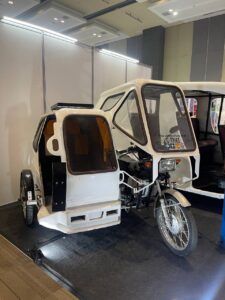
The C-Trike stood out because it doesn’t require drivers to replace their existing gasoline-powered tricycles. It converts them.
According to the project team, operating costs can drop to under ₱1 per kilometer while cutting emissions and extending vehicle life. That’s important in a country where replacing an entire vehicle isn’t always realistic.
Sometimes, the smarter climate solution isn’t replacing what already exists. It’s improving it.
Sometimes Sustainability Is Just One Small Contribution
Not every solution at SUSTEX 2026 involved satellites or electric vehicles.
At the SM Prime booth, visitors added pieces of tela to a large collaborative artwork. Each color represented one of the 17 United Nations Sustainable Development Goals.
Piece by piece, hundreds of individual contributions became one larger image.
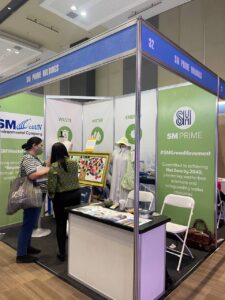
The activity reflected a bigger idea behind the event: sustainability doesn’t happen through one organization or one solution.
SM Prime also showcased initiatives including rainwater harvesting, greywater recycling, rooftop solar panels, EV charging stations, and its Waste-Free Future campaign.
These are examples of how sustainability can become part of places Filipinos already use, rather than remaining an abstract corporate goal.
The Innovation Was Everywhere
The rest of the exhibition offered more pieces of the puzzle.
Republic Cement and Holcim demonstrated ways industrial waste can become construction materials. ChopValue gave discarded chopsticks another life as furniture, while LESSTICS explored solutions for plastic waste.
Other projects focused on resilience. USHER monitors infrastructure health, while WEHLO gathers hydrometeorological data for disaster preparedness.
None claims to solve climate change alone. They don’t have to.
Climate challenges are made up of many smaller problems. Addressing those problems one by one may be how meaningful change actually happens.
READ: What’s Stopping the Philippines From Using Climate Solutions?
The Real Test Comes After SUSTEX 2026
Local government representatives from cities such as Pasig and Parañaque were also exploring the exhibits.
That’s significant because a technology becomes much more interesting when it leaves the exhibition floor. DOST Secretary Renato Solidum Jr. emphasized this idea through Bayanihan Innovation: building a climate-resilient Philippines requires researchers, businesses, government, and communities to work together.
The Philippines already has people developing the ideas. Now comes the harder part: adoption, implementation, and scale.
Because the real measure of climate innovation isn’t how impressive it looks inside a booth.
It’s what happens when it leaves one.