Why is Pickleball Taking Over the Country?
From 244 players in 2020 to over 60,000 today, pickleball isn't just a trend in the Philippines. Here's why it's taking over.
You’ve probably heard it. A sharp, hollow pop. That sound is pickleball. And it is now, officially, everywhere.
What Even Is Pickleball?
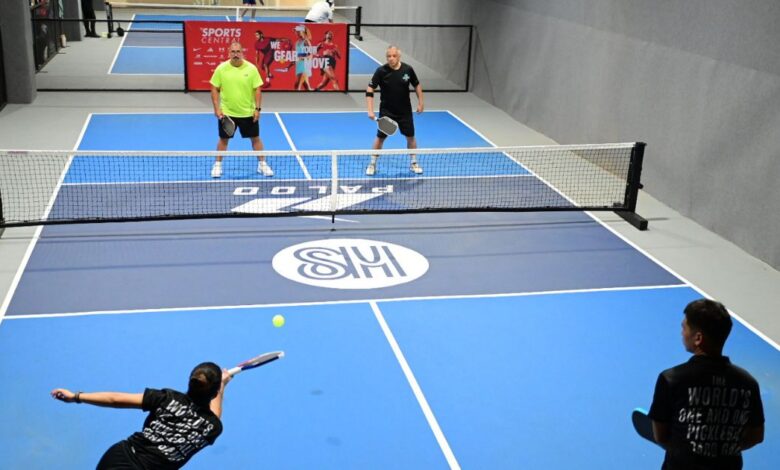
For the uninitiated, and there are fewer of you every month, pickleball is a racket sport played on a court roughly the size of a badminton court, with a paddle slightly larger than a ping-pong bat and a plastic ball with holes in it, not unlike a whiffle ball. The net is lower than in tennis. The scoring is simpler. The court is smaller, which means you spend more time hitting the ball and less time chasing it.
It’s been described as an unlikely hybrid of tennis, badminton, and ping-pong. However, that description is both accurate and slightly undersells it. Because what pickleball actually is, more than any of its technical components, is accessible. You don’t need years of training to rally decently, a full-sized court, expensive equipment, or exceptional athleticism. You only need a paddle, a ball, and at least one other person willing to embarrass themselves alongside you.
The sport was invented in 1965 in the backyard of a Washington state congressman named Joel Pritchard, who improvised a game with a wiffle ball and ping-pong paddles to keep his bored kids occupied. By 1967, the first permanent court was built. A corporation was formed in 1972 to safeguard the sport, and by 1975 and 1976, national media began noticing what they called “America’s newest racquet sport.”
It took about fifty more years for the rest of the world to catch up. And when it did, it caught up fast.
The Global Explosion
In the United States, pickleball’s birthplace, 19.8 million Americans played the sport in 2024, a staggering 311 percent growth over three years. However, by mid-2025, that number had climbed to approximately 22.7 million. Rather quite rapidly, the sport has attracted celebrity investors, professional leagues, and the kind of cultural saturation that makes it nearly impossible to open a news app without seeing something pickleball-adjacent.
The Philippines, in particular, has not just caught the wave. It has become one of the more striking examples of how quickly the sport can take root when conditions are right.
The surest sign that a sport has taken root in the Philippines isn’t Olympic recognition or national championships. Moreover, when SM builds courts for it, you know it’s really hitting mainstream.
SM Supermalls has positioned itself as the home of the country’s largest pickleball destination, helping grow the game by creating more places to play, more opportunities to compete, and stronger communities to connect. Courts are now embedded in SM malls, making pickleball as accessible as a trip to the grocery.
Recently, they even held the first-ever Pickleball Trio Challenge in the SM Active Hub at MOA Complex in Pasay City. A total of 89 teams competed across five qualifying legs held at SM Bicutan, SM Sta. Mesa, SM Sta. Rosa, SM Marikina, and SM Center Muntinlupa, with the top 32 teams advancing to the Grand Finals.
As pickleball gains popularity among Filipinos of all ages, SM Sports and Leisure Center is set to open more pickleball courts in the coming months, making the sport more accessible to more communities across the country.
READ: SM Supermalls: More Than 40 Years of Bringing Filipinos Together
Is This Just a Fad?
Fair question. The Philippines has seen sports trends come and go?
But for a valid reason, pickleball feels different. And the reason is structural rather than hype-driven.
The sport’s accessibility isn’t a marketing claim; it’s a physical reality built into the court dimensions, the equipment cost, and the learning curve. The sport is estimated to be 50 percent easier to learn than tennis, ensuring a constant influx of new players. Every person who picks up a paddle and has fun in their first session becomes a recruiter for the next ten people in their social circle.
The infrastructure is also maturing fast. Courts are being built inside malls, in subdivisions, in barangay gymnasiums. The Philippine Pickleball Federation has official national standing. And Filipino players are competing internationally!
A sport that started as a backyard improvisation in 1965 America, arrived in Cebu as a clinic in 2016, and exploded across a pandemic-shaped country, that doesn’t sound like a fad. That has staying power.
The question now isn’t whether pickleball is going anywhere. It isn’t.
The question is when to schedule the next game.